

CNG vs EV: Which Commercial Vehicle Leads Future Transport
India’s commercial vehicle ecosystem is undergoing a structural shift. The country operates one of the largest three-wheeler and light commercial vehicle (LCV) markets in the world, with millions of vehicles supporting last-mile delivery, e-commerce logistics, urban passenger transport, and small-business supply chains.
For years, CNG-powered commercial vehicles were considered the practical “cleaner alternative” to diesel. However, with rapid advancements in battery technology, strong policy support, and indigenous automotive innovation, electric vehicles (EVs) are increasingly redefining the future of commercial mobility in India.
The discussion today is not simply about cleaner fuel. It is about technological direction, long-term cost efficiency, scalability, and innovation aligned with India’s mobility goals.
Learning About CNG Vehicles
CNG, known as Compressed Natural Gas, has been on the list of greener options for decades. As compared to gasoline- or diesel-powered vehicles, CNG has lower fuel costs and reduced emissions compared to traditional fuels.
These types of vehicles are ideal for fleet operators as they are familiar with technology, fuel mileage, and are fairly easy to maintain. This also shows why CNG vehicles are becoming more prevalent in urban passenger transport and light commercial use.
However, it is important to note that CNG still remains a fossil fuel. While it emits fewer pollutants, it does not fully eliminate the tailpipe emissions. Furthermore, in some regions, there is limited refuelling infrastructure, and reliance on gas prices makes it a transitional rather than a long-term solution.
Understanding Electric Vehicles
Electric vehicles are reshaping the commercial mobility landscape at breakneck speed. With zero tailpipe emissions, lower running costs, and minimal maintenance, electric mobility offers a strong value proposition for businesses.
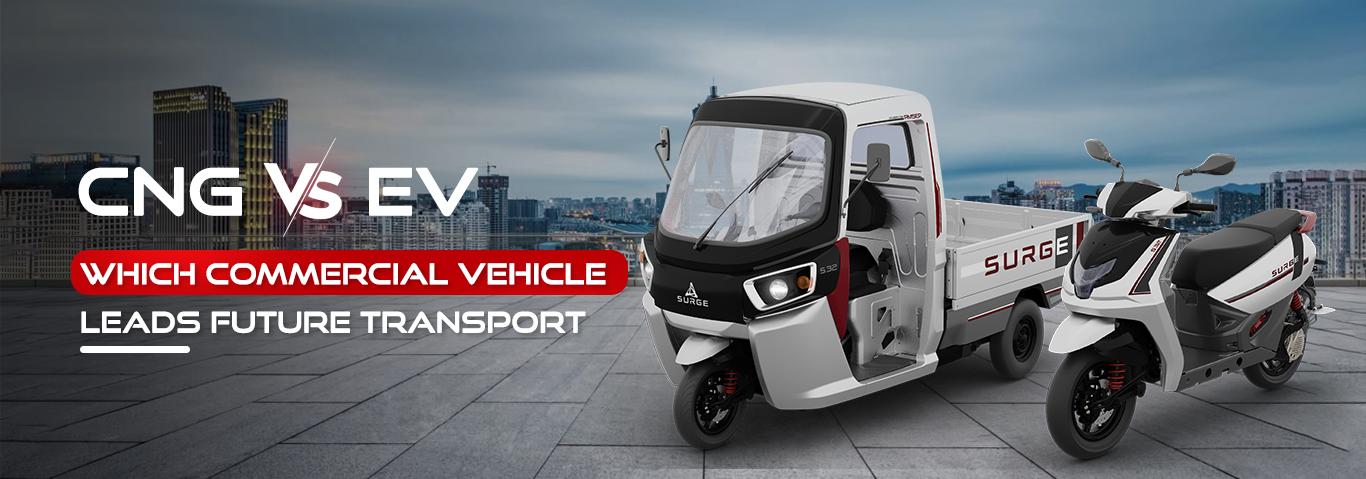
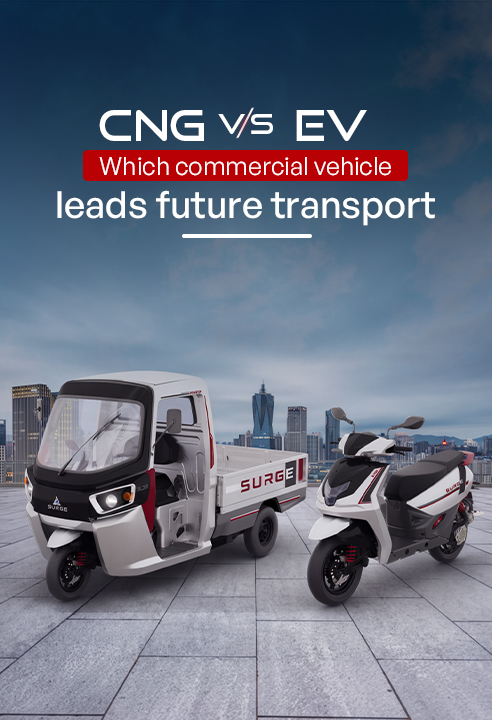
Modern commercial EVs such as Surge S32 are designed specifically for urban and semi-urban operations like last-mile delivery, passenger transport, and quick commerce logistics. They deliver quick acceleration, quieter operation, and better efficiency in stop-and-go traffic.
For example, in cities like Bengaluru and Delhi, several e-commerce and hyperlocal delivery companies have begun shifting their fleets to electric three-wheelers for last-mile operations. These commercial EV deployments have shown measurable reductions in operating costs per kilometre while improving delivery efficiency in high-traffic zones. This shift shows how electric mobility is not just an environmental choice but a strategic operational upgrade for Indian businesses.
Another major advantage of EVs is cost predictability. Electricity prices are more stable than fuel, and EVs significantly reduce expenses related to engine maintenance, oil changes, and wear-and-tear parts.
CNG vs EV: A Practical Comparison
When comparing CNG and electric vehicles for commercial use, the difference becomes clearer when looking at long-term benefits.
Cost Efficiency
In high-usage commercial applications, even small per-kilometre savings lead to high annual operating costs. While CNG vehicles have a lower upfront cost. However, electric vehicles often deliver better total cost of ownership(TCO) due to:
- Reduced maintenance costs
- Lower downtime
- Lower energy cost per kilometre
Environmental Impact
CNG reduces emissions when compared to diesel but as mentioned above it does not eliminate them. Methane-based fuel still contributes to greenhouse gases.
On the other hand, EVs eliminate tailpipe emissions completely. These innovations are highly valuable in urban areas struggling with hazardous Air Quality Index (AQI) levels. As India moves towards stricter emission policies and carbon reduction goals, commercial EVs are becoming more aligned with long-term sustainability frameworks.
Adaptability
One of the defining strengths of electric vehicles is platform flexibility. Electric architecture allows modular vehicle development because the drivetrain is compact and scalable. At the same time, CNG vehicles remain limited by fuel dependency and combustion-based technology, which may provide some restrictions on innovation.
A strong example of adaptability in electric mobility is the Surge S32, a convertible electric vehicle engineered for Indian commercial conditions. The Surge S32 is designed to transition between a three-wheeler commercial configuration and a two-wheeler format. This allows operators to:
- Deploy the three-wheeler configuration for cargo operations
- Detach and use the two-wheeler unit for personal mobility or last-mile passenger movement
- Optimise asset utilisation across different business needs
This level of flexibility reduces the need for multiple vehicle investments.
Future Readiness
The future of electric mobility is bright, as governments and urban planners are actively promoting it through incentives, charging infrastructure installations, and policy support. This is giving EVs a clear edge.
Furthermore, India’s innovation ecosystem is also accelerating this transition. Initiatives such as FAME (Faster Adoption and Manufacturing of Electric Vehicles) and state-level EV policies are encouraging domestic manufacturing, battery innovation, and modular vehicle design.
As a result, Indian manufacturers are not just adopting electric vehicle technology but actively developing next-generation commercial EV platforms tailored to Indian road conditions and logistics patterns.
Electric Vehicles: Leading the Future
The great transformation toward electric mobility is not only about sustainability, but also about smarter operations.
As commercial mobility continues to develop, the growing demand for a preferred choice for businesses to stay compliant and cost-effective is also increasing. This is where the convertible-vehicle Surge S32 comes in. This vehicle is a classic example of a modular, class-changing electric vehicle designed for real-world commercial use. Built to seamlessly transition between three-wheeler and two-wheeler and vice versa, the vehicle supports passenger movement, cargo delivery, and personal commute requirements within a single electric vehicle.
This level of adaptability also allows operators to maximise asset utilisation while reducing operational complexity. By combining electric efficiency with flexible design, the Surge S32 shows how the next generation of commercial EVs are shaping smarter, more sustainable urban transport.
FAQs
1. Do you think that electric vehicles are better than CNG vehicles for the future?
Yes, EVs come with greater sustainability, lower long-term costs and with better total cost of ownership (TCO).
2. Is maintaining EVs more costly than CNG Vehicles?
Not at all, EVs generally require less maintenance due to advanced yet advanced yet simple power trains as compared to complex IC (internal combustion) engines.
3. Is CNG still a better option today?
CNG remains useful in certain scenarios but is increasingly seen as a transitional solution.
4. What makes Surge S32 unique in India’s EV ecosystem?
Its convertible architecture allows it to function as both a three-wheeler and a two-wheeler, maximising commercial flexibility and asset utilisation.


