

Is Commercial EV the Right Fit for India's Everyday Transport Needs?
India does not just participate in the global electric three-wheeler market, it leads it. In 2024, India held 57% of global electric three-wheeler sales, according to the International Council on Clean Transportation. Three-wheeler sales in FY2024-25 hit a record 7.41 lakh units, a 6.7% year-on-year increase. The electric three-wheeler market itself was valued at USD 1.16 billion in 2024 and is projected to reach USD 4.08 billion by 2034.
Those are big numbers, but they represent something far more personal: the daily lives and practical needs of real operators. They are about the auto driver who starts at 5 AM, the delivery partner handling 40 drops a day, and the small trader who needs a cargo vehicle in the morning and a way home in the evening. For them, the question is not whether electric commercial vehicles are growing. It is whether any of them actually fits in their life.
The Economics Behind India's Commercial EV Shift
The shift toward commercial EVs in India has not been driven by ideology. It has been driven by economics.
Fuel prices have climbed steadily. A CNG or petrol-run three-wheeler costs between ₹300 and ₹400 per day in fuel alone, depending on the city and daily distance. An electric equivalent brings that operating cost down considerably, typically to under ₹100 per day at current electricity rates. For a driver covering 80 to 100 kilometres daily, that difference translates into significant savings within weeks.
Government policy has reinforced this transition. The FAME and PM E-Drive schemes have worked to narrow the upfront cost gap between electric and petrol three-wheelers. Subsidies on vehicle cost, GST reductions, and road tax exemptions have brought first-time buyers into the segment who would otherwise have remained on the sidelines.
The environmental dimension reflects the same logic. Delhi recorded EV penetration in electric commercial three-wheelers at 74.8% in 2024, a figure that owes as much to operator economics as it does to policy. Most who made the switch did so because the numbers supported it.
Where the Gap Still Exists
- Most electric commercial vehicles in India are purpose-built, a cargo three-wheeler carries goods, a passenger auto carries people, a scooter moves one rider. Each is built for one job and cannot serve another.
- A large share of India's working population operates across multiple use cases in a single day, deliveries in the morning, passenger trips or personal travel in the second half. The current market offers no single vehicle that covers both.
- Owning two separate vehicles to bridge this gap means double the cost, double the insurance, and double the maintenance, an expense that does not make financial sense for most self-employed individuals and gig workers.
- Electric commercial vehicles that sit idle for six hours a day is a cost, not an investment. Vehicle utilisation directly determines whether an EV makes economic sense for a working operator, and this is the gap most of the commercial EV market in India has not addressed.
What the Surge S32 Changes
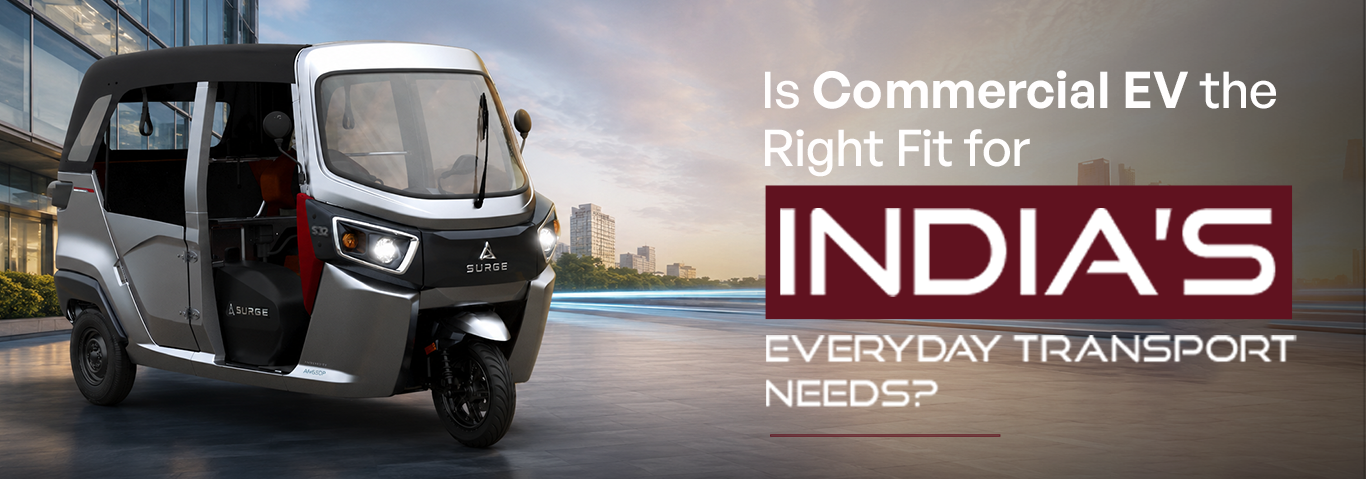
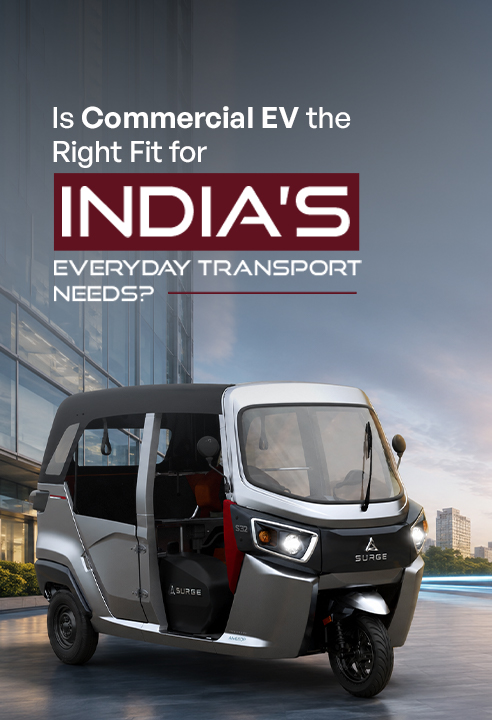
The Surge S32 approaches this problem from a different direction entirely. Rather than asking buyers to choose between personal and commercial use, it builds both into one platform. The S32 converts between a two-wheeler and a three-wheeler in under three minutes. The buyer invests in one platform and selects the three-wheeler body that matches their primary income source. The scooter is always available for personal use when the commercial configuration is not needed.
This is not a compromise product that does both things adequately. Each powertrain is independent, each battery is independent, and the conversion is electromechanically controlled, not a manual workaround. The SURGE EV holds 50+ patents and S32 was built on a grounds-up modular AMSEP electric vehicle platform, designed specifically for multi-configuration use.
The Regulatory Part Most People Miss
One of the very significant thing about SURGE S32 is that it's one of a kind in the world and the Indian Ministry has also created a new category and norms for these kind of vehicles and also approved S32 as per these norm
This category defines a two-wheeler and three-wheeler combination that can be separated and rejoined as needed.
The creation of this new category reflects a broader shift in how India's transport needs are being understood. As vehicle concepts evolve to match real-world usage patterns, existing classifications naturally need to expand alongside them. A vehicle that functions as both a scooter and a three-wheeler is not an edge case, it represents how a significant portion of working India actually uses vehicles, and regulatory frameworks are gradually catching up to reflect that reality
Is a Commercial EV the Right Fit?
For single-purpose operations, a fleet delivery operator on a fixed route, a passenger auto driver working a defined shift, the answer is yes. Purpose-built commercial EVs are well-suited to these use cases, and the economics of electrification over petrol or CNG are compelling.
For the broader segment of self-employed individuals, small traders, and gig workers who require a vehicle to serve multiple roles across a working day, most commercial EVs available today offer only a partial solution.
The Surge S32 addresses this directly. It does not position itself against purpose-built electric commercial vehicles. It serves the segment those vehicles were never designed for, and that segment represents a significant share of India's working population.
FAQs
Q1. What makes the Surge S32 different from other commercial EVs in India?
It is the world's first vehicle to convert between a two-wheeler and a three-wheeler in under three minutes, with independent powertrains for each configuration, purpose-built for both personal and commercial use from a single platform.
Q2. Who is the Surge S32 built for?
Self-employed individuals like delivery partners, fleet owners catering to multiple types of logistic solutions, ride-share drivers, and small traders who need one vehicle to serve both personal and commercial purposes without the expense of owning two.
Q3. What three-wheeler configurations does the S32 offer?
Four variants, PV (passenger), LD (low deck), HD (high deck), and FB (flatbed), all built on the same scooter base. The buyer chooses the configuration that fits their primary use case.


