

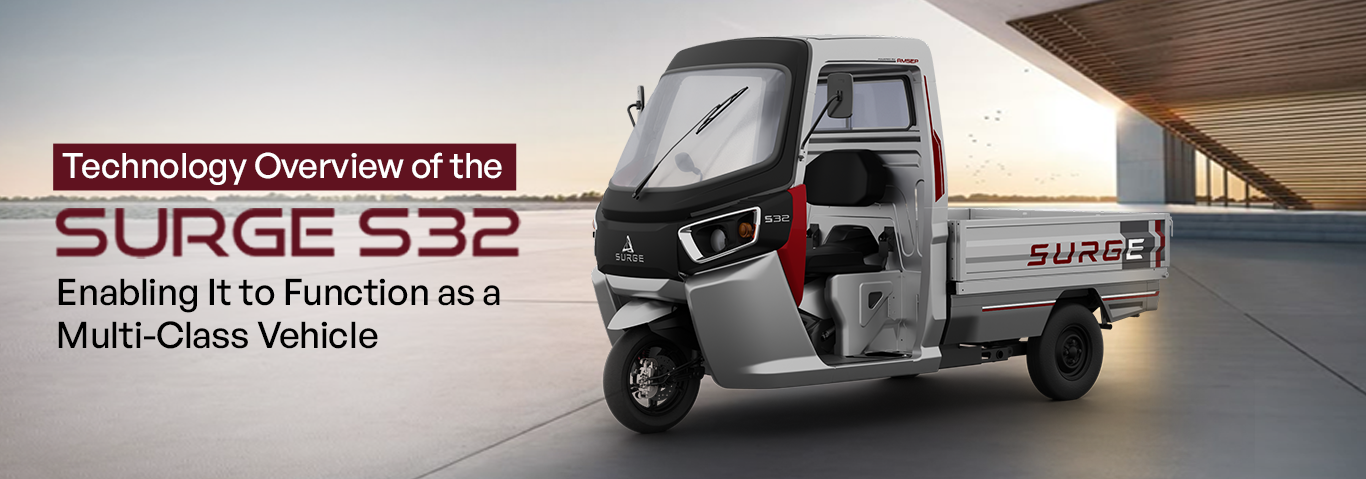
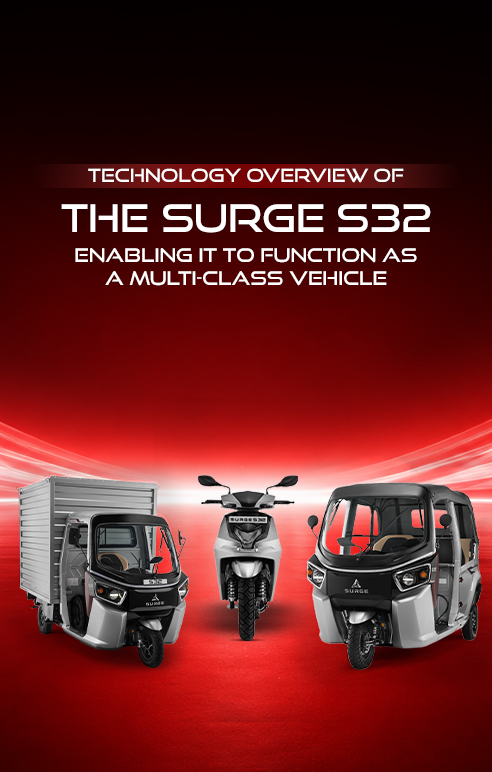
Technology Overview of the Surge S32: Enabling It to Function as a Multi-Class Vehicle
Most commercial EVs on Indian roads are built around a single use case: a three-wheeler for cargo, a scooter for city commuting, a passenger auto for ride-sharing. The Surge S32 takes a different approach. Built on the AMSEP platform, it is engineered to span L2 to L5 classifications without compromising the structural, drivetrain, or regulatory requirements specific to any one class.
This capability comes from a defined technology stack, developed in-house and covered by 50+ patents. Each system in that stack addresses a specific engineering constraint, from variable load-bearing architecture to configuration-dependent drivetrain calibration to a mechanism for physical reconfiguration between vehicle forms.
This blog breaks down those technologies: what they are, what they do, and why they matter for anyone evaluating the Surge S32 as a commercial or personal asset.
The Foundation: AMSEP
Every technology on the Surge S32 is built on the AMSEP, the Advanced Modular Scalable Electric Platform. This is the structural and mechanical backbone of the three-wheeler body. It comprises independent powertrains, battery packs & smart systems which automatically determines the vehicle mode and activates components of that system. It is also the platform on which all four three-wheeler body variants, PV, LD, HD, and FB, are built.
The "scalable" in AMSEP refers to the platform's ability to support different vehicle configurations. Instead of being limited to a single model, the same platform can be adapted for multiple three-wheeler variants by making changes where needed.
The Conversion System: Patented Interchange Mechanism
Another crucial technology on the Surge S32 is the conversion system itself. The Surge scooter, which forms the front section of the vehicle and functions as the driver's cockpit, can be separated from the three-wheeler rear body and used as a fully independent two-wheeler. The process of docking and undocking takes just three minutes, through a simple operation assisted by the S32's patented Interchange Mechanism, with no special tools required.
The Interchange Mechanism manages the physical separation and unification of the two chassis. It controls wheel retraction and clamping, ensuring these processes occur only during the conversion process and not during normal vehicle operation. A durable electromechanical locking mechanism ensures the two chassis are robustly unified during 3W operation, making accidental separation mechanically impossible while the vehicle is in motion.
To understand how this conversion plays out across a full working day, read: Life in Motion: Experiencing A Day With Surge S32
The Powertrain Architecture: SSMP
Operating as two distinct vehicle classes requires two distinct powertrains. The Surge S32 handles this through the SSMP, the Smart Switching Multi Powertrain system. The scooter carries its own dedicated motor and battery pack. The three-wheeler rear body carries its own separate motor and battery system. When the vehicle operates in 3W mode, the rear powertrain drives the vehicle. When the scooter separates and operates independently, its own powertrain engages automatically.
Both the scooter and the three-wheeler are equipped with individual charging connectors and chargers. This means each mode can be charged independently. A driver can charge the scooter battery during the morning's three-wheeler run, and arrive at the next leg of their shift with both systems ready, without waiting on a single combined charge cycle.
This dual powertrain approach is also what qualifies the Surge S32 as an L2-5 category vehicle and a true EV smart mobility solution, India's first in this classification. Each configuration meets the technical and regulatory requirements of its respective vehicle class, which is only possible because each runs on its own independent powertrain.
ATIS: Conversion Across Terrain
A conversion mechanism that only works on flat, smooth surfaces has limited commercial utility in Indian operating conditions. The Surge S32 addresses this through ATIS, the All Terrain Interchange System, which is designed to enable conversion across multiple surface conditions. Drivers are not restricted to a specific environment when switching between modes, which is important for delivery and logistics operators working across urban and semi-urban routes with variable road quality.
Safety Engineering Built Into the Platform
The technology on the Surge S32 is not limited to conversion and powertrain systems. The safety architecture is equally specific.
The three-wheeler is constructed on a heavy-duty ladder frame, built to support substantial load-carrying capacity during 3W Cargo operations and provide structural stability during multi-stop commercial routes. The all-metal body adds durability and extends vehicle life across the kind of daily use that commercial operators put their assets through. As a multipurpose EV utility vehicle, the S32's battery packs are tested for one lakh kilometres and carry multiple safety parameters including thermal safety, a standard built for vehicles operating across long commercial duty cycles on Indian roads.
To see how these safety standards translate into real-world commercial use, read: Increase Your Earnings as a Passenger Vehicle Driver with Surge S32
Conclusion
The Surge S32 functions as a multi-class vehicle because it was built as one from the ground up, not adapted into one after the fact. The AMSEP serves as the EV modular platform that makes everything else possible. The Interchange Mechanism, SSMP, and ATIS work together to deliver genuine EV smart mobility across vehicle classes, terrains, and commercial use cases. For delivery partners, fleet operators, and self-employed drivers evaluating a multi purpose electric vehicle that earns across every hour of the day, the S32's technology stack is what makes the economics work. It is not one vehicle doing two jobs loosely. It is one platform engineered precisely to do both.
To explore how the Surge S32 fits into sustainable urban mobility, read: How Convertible Electric Vehicles Shape a Sustainable Future for Urban Planning
Ready to explore the Surge S32 for your delivery or commercial operations? Register your enquiry at surgefuturemobility.com
FAQs
What makes the Surge S32 different from other electric three-wheelers in India?
The Surge S32 is India's first L2-5 category vehicle. Unlike conventional electric three-wheelers, it converts into a fully functional two-wheeler scooter in just three minutes without any hassle.
How many patents does the Surge S32 hold?
Surge has filed over 50 patents for the technologies developed in-house for the S32, including the AMSEP platform, Interchange Mechanism, and SSMP powertrain architecture.
Is the Surge S32 suitable for both urban and semi-urban road conditions?
Yes. The ATIS (All Terrain Interchange System) is designed to enable conversion across multiple surface conditions, making the S32 practical for operators working across varied road environments, not just smooth urban roads.
Can a fleet operator purchase multiple variants on the same platform?
Yes. All four variants, PV, LD, HD, and FB, are built on the same AMSEP platform with the same scooter base. A fleet operator can deploy different rear body configurations depending on the use case while standardising on the same core platform and powertrain architecture.


