

The Global Move to Electric Vehicles and the Need for Responsible Adoption
The shift toward electric mobility is no longer a future concept; it is actively reshaping how the world moves. Governments across the world, from developed to developing nations, are setting ambitious targets to reduce emissions, with plans to phase out internal combustion vehicles over the next decade.
The intent is clear: cut carbon emissions and reduce pollution. Yet the transition isn't straightforward as it appears. Market signals show that demand for electric vehicles is stabilising in several regions, raising an important question: Are we moving too fast without solving the basics?
The Reality Check: What's Slowing EV Adoption?
Despite strong policy support, real-world challenges continue to affect adoption rates. Buyers are still cautious, and the reasons are practical, not ideological.
- Charging infrastructure gaps remain a major concern, especially in developing and semi-urban regions
- High upfront costs make EVs less accessible to a large segment of users
- Range limitations create uncertainty for daily and long-distance travel
- Limited product variety reduces flexibility for different use cases
Addressing these gaps requires smarter solutions such as robust electric vehicle battery safety, efficient energy systems, and versatile design in the form of a multi purpose electric vehicle. These factors matter because adoption depends not only on technology, but also on how reliably that technology fits into everyday life.
Why Responsible Adoption Matters More Than Speed
Pushing electrification faster than the supporting ecosystem may create new pressure points instead of solving old ones. Charging demand affects not just vehicles, but also grids, utilities, and local infrastructure, so the transition has to be coordinated rather than rushed.
That is especially true in emerging markets, where EV adoption is growing quickly but still depends on practical factors such as reliable electricity access, charging convenience, and total cost of ownership.
A responsible transition also depends on grid readiness, because even the best EV technology can only scale smoothly when power systems are prepared to support it. At the same time, cost efficiency matters just as much, since users adopt EVs faster when the total ownership cost makes practical sense.
That is why experts increasingly emphasize balanced adoption, where policy, infrastructure, and user needs move together. In this stage of the transition, the focus should be on practical solutions that improve efficiency, reliability, and access for both individual users and commercial operators.
Engineering the Transition: Where Innovation Fits In
The solution lies in designing vehicles and systems that fit real-world usage patterns. Instead of forcing users to adapt to EVs, the technology needs to adapt to how people actually work, travel, and earn.
That means focusing on:
- Flexible vehicle design that supports multiple use cases.
- Efficient energy management systems that reduce waste.
- Smarter charging and utilisation patterns that lower downtime.
- Lower total cost of ownership for individuals and businesses.
How the Surge S32 Brings Practical Innovation
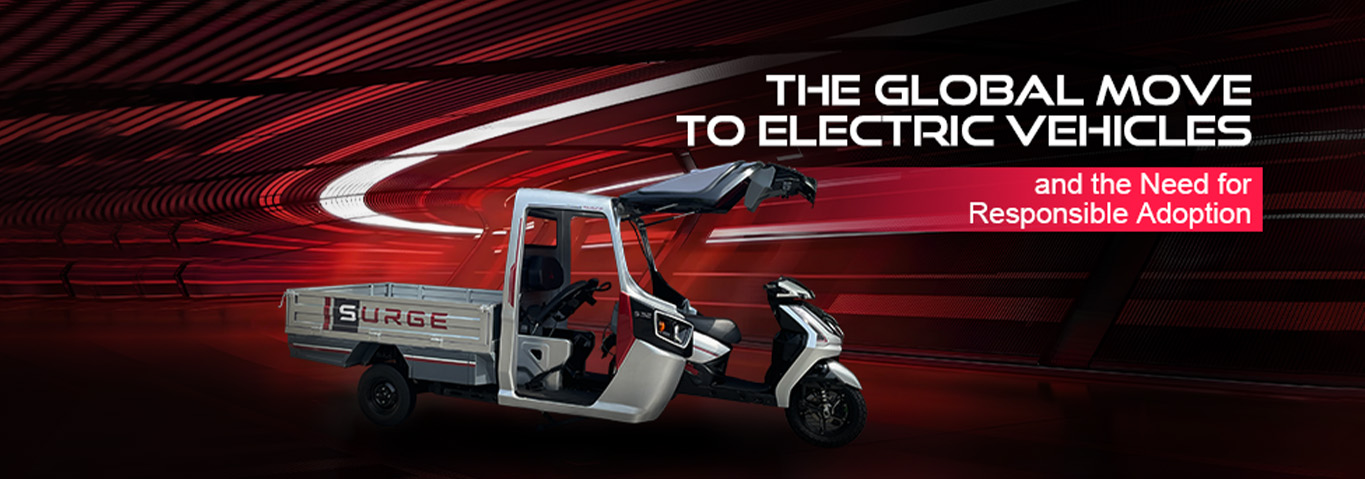
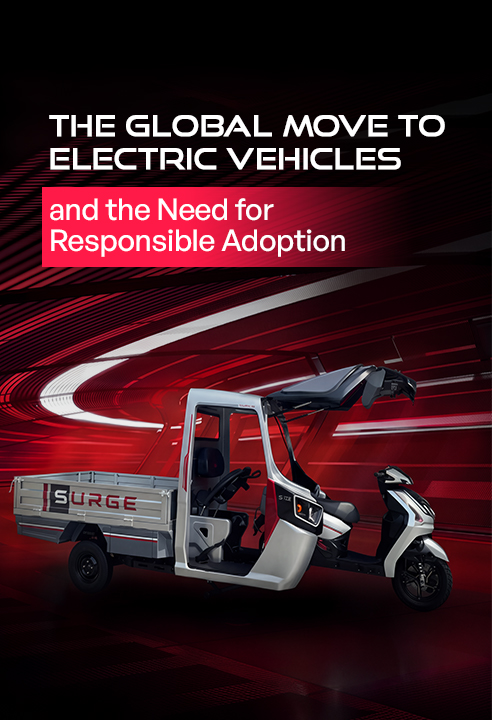
Electric mobility will succeed not only through policy, but through practical engineering that makes adoption easier, more efficient, and more dependable. That is where the Surge S32 stands out. It is not just another electric vehicle; it is designed as a class-shifting vehicle that can transform between two-wheeler and three-wheeler vehicle, depending on what the day demands.
The idea behind the multi purpose electric vehicle is simple but powerful: one platform can support different kinds of mobility without forcing the user to buy and maintain two separate vehicles.
In two-wheeler mode, it offers speed and agility for urban movement. In three-wheeler mode, it shifts into a load-carrying setup that is better suited for commercial use, deliveries, or other business tasks.
This matters because many EVs are still designed for a single use case, but users often need more than one. A delivery rider, small business owner, or urban commuter may need one vehicle that can do multiple jobs in a day.
By improving asset productivity, lowering idle time, and increase in earning potential, the Surge S32 electric 3 wheeler fits the logic of responsible adoption much better than a vehicle built for only one function.
Bridging Sustainability and Income
What makes the Surge S32 relevant in the global EV conversation is not just that it is electric, but that it is built around real-world utility. Sustainability becomes more meaningful when a vehicle is used frequently and productively, because that improves the value generated from the same energy, and ownership cost.
For users, this can mean:
- Better asset utilisation.
- Lower dependence on separate vehicles for different tasks.
- More practical earning opportunities from a single platform.
- A design that matches changing mobility needs.
This approach aligns with responsible adoption, where technology is designed to work within existing economic and infrastructure conditions rather than assuming ideal conditions already exist.
Wrapping Up
The global shift to electric vehicles is moving from ambition to real-world application, and that means practicality now matters as much as innovation. The most effective solutions are the ones that fit everyday use, support commercial activity, and make electric mobility easier to adopt.
The Surge S32 fits into that idea well because it offers a flexible platform built for more than one kind of mobility. Instead of serving only a single purpose, it is designed to support different use cases through one vehicle.
FAQs
1. What is responsible adoption of electric vehicles?
Responsible adoption means introducing electric vehicles in a way that balances sustainability with real-world usability. It involves building proper charging infrastructure, ensuring affordability, and designing vehicles that meet practical daily needs instead of forcing a quick transition without readiness.
2. What is a class-shifting vehicle like the Surge S32?
A class-shifting vehicle is designed to operate in more than one category. The Surge S32 can operate as both a two-wheeler and a three-wheeler, allowing users to switch between speed-focused and load-carrying configurations as needed.
3. How does the Surge S32 support sustainable income?
The Surge S32 enables multiple use cases within a single day, such as cargo transport, quick deliveries, and personal mobility. This improves vehicle utilisation, reduces idle time, and allows users to generate income across various activities through a single platform.


