

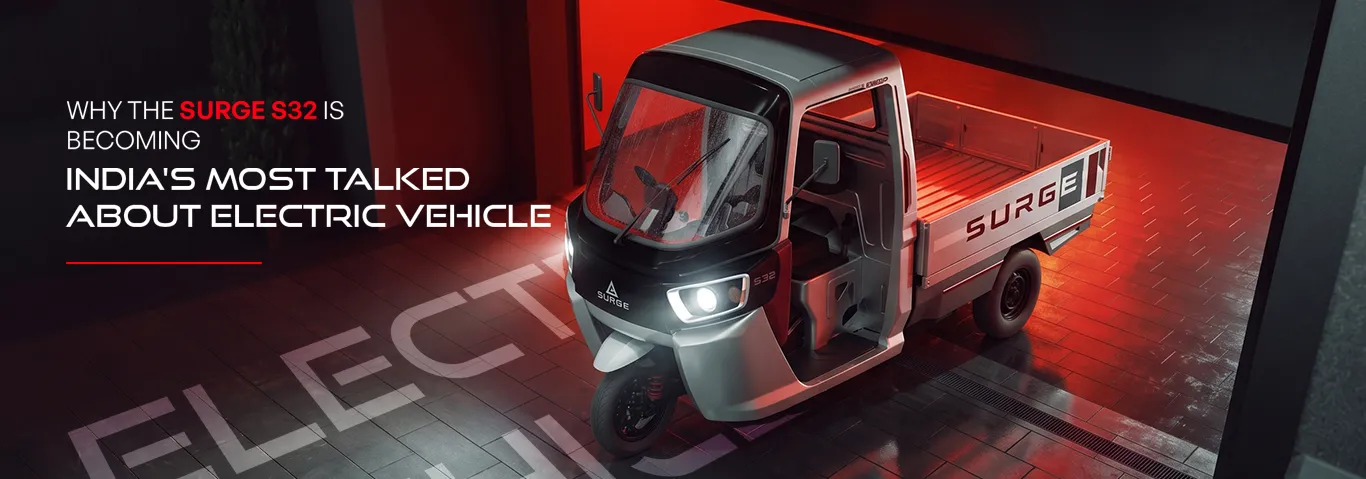
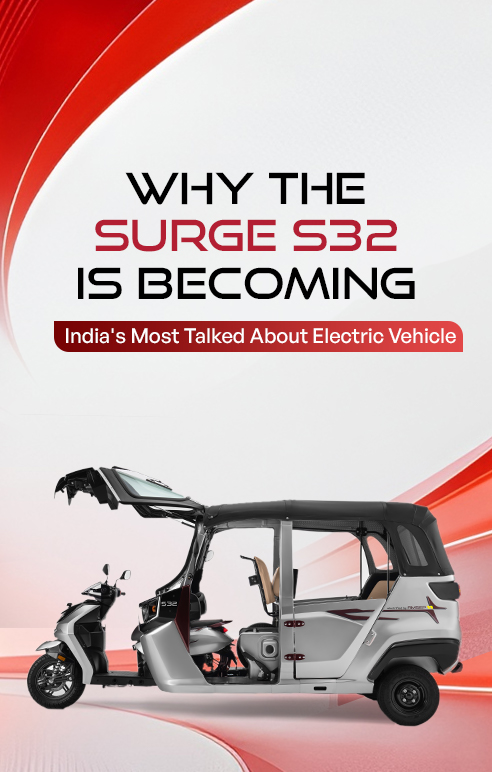
Why the Surge S32 Is Becoming India's Most Talked About Electric Vehicle
India's electric vehicle market moves fast. New launches, revised specs, and updated price points arrive almost every quarter. Most of that movement is lateral: better range on the same scooter, a revised cabin on the same auto, a lower price on last year's product. Most incremental upgrades refine what already exists. The Surge S32 represents a vehicle of a new era, one that does not improve an existing category but establishes an entirely new one.
A single platform engineered to switch configurations in under three minutes, cover both commercial and personal duty cycles within the same day, and operate under L2-5, a government classification that exists specifically for this format. That combination has no precedent in the Indian and global electric mobility market, and it is precisely what has drawn attention.
What Owning a Surge S32 Actually Gets You
1. One vehicle, a full working day
Most EVs in India require the operator to adapt life around the vehicle. The S32 is built around how Indian operators actually live and work. A typical day with the S32 might look like this: early morning grocery and milk-run deliveries in three-wheeler mode, daytime e-commerce drops for platforms like Amazon and Flipkart, afternoon cargo runs for B2B logistics, and by evening, a quick switch back to scooter mode for personal errands or family travel. The same vehicle supports an income stream through the day and personal mobility once work ends.
2. Select from four commercial configurations
The S32 supports four commercial configurations: passenger transport, grocery and produce delivery, e-commerce logistics, and open-deck cargo transport. The body variant you choose aligns with your actual work, not a generic use case someone else decided for you.
3. Cut your fixed ownership costs significantly
Owning a dedicated electric three-wheeler commercial vehicle and a separate scooter means two loan repayments, two insurance premiums, and two maintenance cycles. The S32 consolidates all of that into a single asset, a single EMI, and a single servicing schedule. For a gig operator or small fleet owner, that reduction in fixed overhead, on top of the lower running cost, has a direct impact on take-home earnings every month.
4. Built to handle daily wear and tear
The all-metal body, heavy-duty ladder frame, and battery packs are rigorously tested for safety and durability. This means the vehicle holds up across the kind of roads and conditions most Indian operators face daily.
5. Convert in under three minutes
The Interchange Mechanism enables the electric vehicle conversion from a three-wheeler to a two-wheeler in under three minutes, without any hassle. Any operator can complete the process independently, on almost every kind of terrain, at any point during the day.
6. Independent charging for each unit
The S32 scooter and the rear module are packed with separate battery packs with individual charging connectors and chargers. The scooter carries a 3.5 kWh battery, while the rear module carries an 11.62 kWh battery. Both charge independently based on usage demand. If the scooter requires a top-up before the rear module does, charge only the scooter. Productive hours are never held back by a single battery cycle.
7. Backed by regulatory approval and design recognition
The L2-5 classification reflects a broader evolution in vehicle categories, created to accommodate convertible formats like this one as India's transport needs continue to shift. The Surge S32's design has also earned recognition on the global stage, including the Red Dot Award in the Design Concept category for Commercial Vehicles, one of the most widely recognised design accolades worldwide, alongside the Platinum A' Design Award in 2024 in the Vehicle, Mobility, and Transportation Design category.
Built for Bharat, Not Just Metro Corridors
Most electric mobility conversations in India centre around Bengaluru, Pune, Delhi, and Hyderabad. The S32 is designed for a wider operational reality: tier-2 cities, semi-urban towns, and gig workers who move between commercial and personal roles multiple times within a single day. The need it addresses is not geographic. It is economical.
For businesses, this also means rethinking warehouse to hub operations, where a single vehicle can move goods from storage to last-mile drop points without switching fleets. This is opening up a new way of doing business for operators who previously had no flexible option between bulk transport and individual delivery.
Conclusion
The Surge S32 is drawing attention because it solves a real problem with engineering rigour rather than incremental feature additions. India has millions of working operators who need a vehicle that handles commercial and personal use across formats, hours, and conditions. The electric vehicle conversion mechanism at the core of the S32 is what separates it from every other product in this segment. A platform that transitions between a scooter and a fully functional electric three-wheeler, proving that one well-designed asset can do the work of two.
FAQs
Can the 2-wheeler and 3-wheeler modules of the Surge S32 be charged separately?
Yes. Both modules carry individual charging connectors and chargers, allowing each to be charged independently according to operational demand.
Is the Surge S32 suitable for delivery work?
Yes, the S32 LD and S32 HD variants are purpose-built for commercial cargo use. The HD variant carries up to 500 kg payload. The ability to detach the scooter after delivery shifts gives operators a level of operational flexibility unavailable in any other electric three-wheeler in the segment.
Can any Surge S32 scooter be paired with any 3-wheeler body?
No. Each two-wheeler is electro-mechanically paired with a specific three-wheeler body. The pairing operates on a software enabled pairing and cannot be interchanged with other units.
Is the Surge S32 approved for road use in India?
Yes. The Government of India has created a new vehicle classification, L2-5, specifically to accommodate the S32's convertible format, and the vehicle is registered under this category.


